Sixth and Duval
Navy Hill had a school with Black teachers before Richmond had public schools at all. The city put a highway and an arena on top of it.
The Richmond Coliseum comes down this year. The Commonwealth has put $15 million toward the demolition, bids may go out in September, and nine and a half acres of downtown will be graded and sold for a hotel.
Before the arena there was a highway. Before the highway there was a neighborhood, and this is that neighborhood.
The hill
Navy Hill sat on high ground north of the city, and for most of the nineteenth century it was barely part of Richmond at all. Two deep ravines separated it from downtown. You reached it by footbridge and carriage path. It was a satellite, close enough to see, far enough to be its own thing.
The name is older than the community. In 1816, four speculators, John G. Gamble, John Goddin, Peter Ralston, and John Barfoot, platted a subdivision on the tract and gave it a War of 1812 theme, with a naval victory column at the center and streets radiating out named for American commodores. The postwar economy collapsed. The column was never raised. The streets were never cut. The name stayed on the empty ground.
German immigrants settled it from the 1810s through the 1850s. Then the electric streetcar arrived in 1888, a line eventually ran up Fifth Street toward Highland Park, and the ravines stopped mattering. By the turn of the century Navy Hill was a Black neighborhood.
Its edges moved depending on who was describing them. Mid-nineteenth-century accounts put it north of Leigh between Third and Tenth. The state historical marker gives North Third to Thirteenth. The northern line runs at least to Duval and Preston, possibly to Shockoe Hill Cemetery. Nobody has ever fixed it precisely, because the people who lived there did not need it fixed.
Third Street
Jackson Ward ran west from about Third Street to Belvidere, north of Broad. Navy Hill began at Third and ran east to Tenth or Thirteenth, north of Leigh. The two abutted at Third. Both were majority Black by the turn of the century, and the same highway took both.
Jackson Ward got its name in the 1870s, when Richmond's all-white city council redrew the voting wards and moved Black voters into one district. They elected a single council seat. White Richmonders held the other five. Once that was settled the council dissolved the ward, and the name stayed on the neighborhood. The people in it filled it with banks, insurance societies, fraternal orders, and theaters.
Navy Hill's name came off the 1816 plat.
People moved between the two, and some Jackson Ward business owners kept houses on the hill. Bill "Bojangles" Robinson had a home in Navy Hill. He paid out of pocket who paid out of pocket for a traffic light in Jackson Ward so children could cross safely. One account places Maggie Lena Walker's early years on Navy Hill before her Jackson Ward house; that rests on a single source, and her documented home is on East Leigh.
Navy Hill had its own school, its own market corner, its own barber shop, its own restaurants and grocery stores and churches. It had its own name a half-century before there was a Jackson Ward.
The school
Richmond did not open public schools until 1869. Navy Hill had one before that.
The Richmond Educational Association ran a school for Black children in a cluster of frame buildings on the hill, staffed by Black teachers, under a principal named R. M. Manly, a former Union Army chaplain who secured its funding through the Freedmen's Bureau. When the city finally built a public system, the School Board rented the Navy Hill buildings and kept the Black teachers on.
For decades afterward, Navy Hill School was the only public school in Richmond with a Black faculty. The principal's chair went to a white appointee for many years. The classrooms did not.
The teachers are named in the record
- Peter Woolfolk, the first Black teacher in Richmond's public schools.
- Lizzie Knowles, a northern missionary teacher, principal from 1873 to 1878, afterward moved to the Richmond Colored Normal School.
- Daniel Webster Davis, began teaching there in 1879. Born enslaved in Caroline County in 1862, he graduated with honors from the Richmond High and Normal School at sixteen. He became a poet, minister, and popular speaker who toured the United States and Canada, and published two volumes of poetry before his death in 1913.
- Daniel Barclay Williams, teaching through the 1880s.
The frame buildings gave way to a two-story, seventeen-room brick building that opened on April 14, 1893. The old structures stood disused for another sixty years.
In 1952, when the school added an auditorium and cafeteria that year, builders had to drive piling roughly sixty-five feet down, because part of the site sat on fill. The ground under Navy Hill was itself made ground: a ravine filled, built on, and eventually filled a second time with the neighborhood's own rubble.
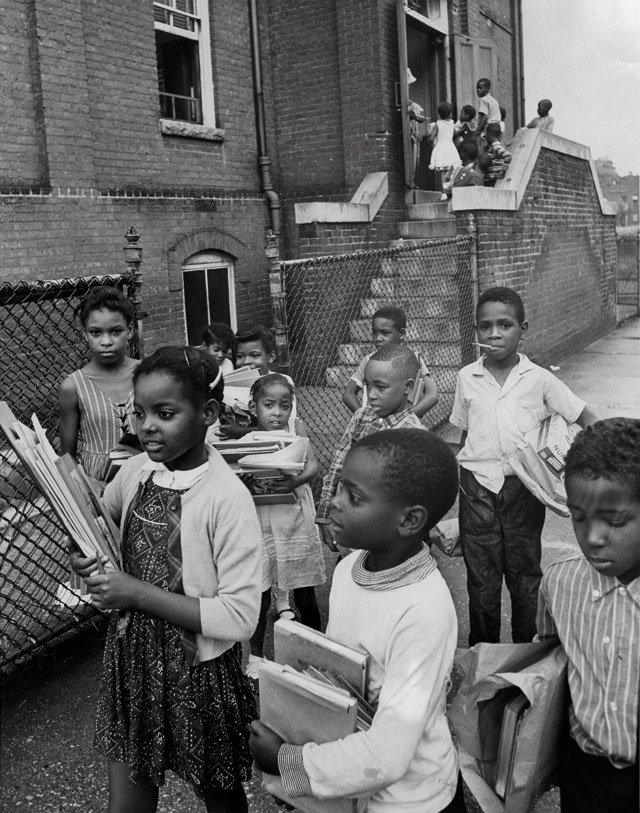
On Fridays, the children were allowed to visit the house of a man everyone called Mr. Folly. He played the piano and the children danced. They stayed one hour. Robnette Moore, who grew up in Navy Hill from the 1920s, remembered this seventy years later. They always knew when it was time to come home.
One street
Albert V. Norrell was born enslaved. He taught in Richmond for sixty-six years, Navy Hill among them, and lived at 1015 North Seventh Street. His sisters lived there too. His family owned about four houses on that one street, and his granddaughter Faithe remembered childhood there as moving from house to house, aunt to aunt, without ever really leaving home.
A school in Northside carries his name now. Faithe Norrell taught in Richmond Public Schools until she retired in 2017. Counted end to end, the family put a direct descendant in a Richmond classroom or a Richmond principal's office for 133 consecutive years. She calls it the family business.
Earle P. Taylor's family lived in the 1000 block of North Seventh. The same block. Taylor became a photographer and an educator. When the bulldozers came for his family's house, he stood in the street and photographed it, and that photograph is now in the Valentine's collection.
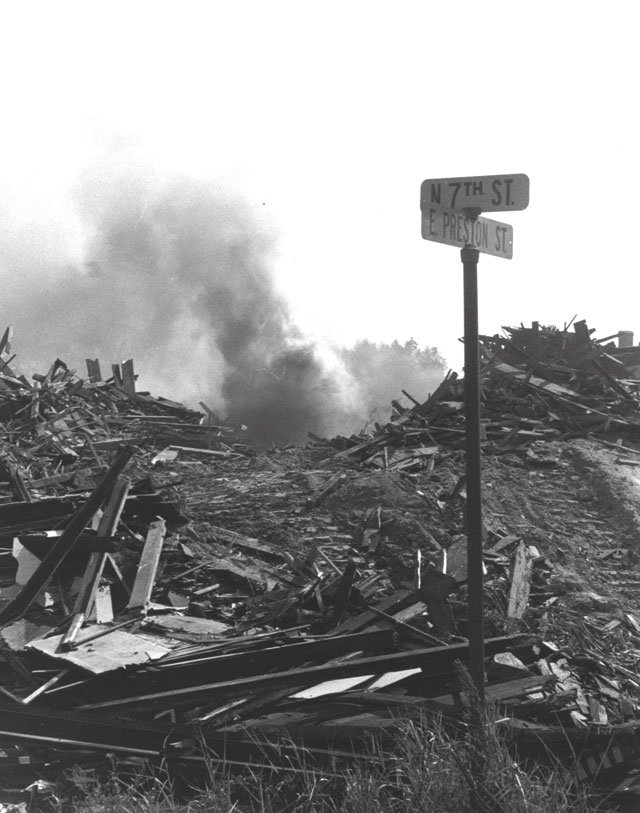
Kia Player's great-grandparents raised thirteen children in a wood-frame house at 904 Turpin Street. Three generations later the family still refers to the place by its number.
The school gymnasium survived the clearance. The Children's Museum of Richmond moved into it in 1977 and operated there until 2000. For twenty-three years, Richmond children played inside the last standing piece of a school that had educated Black children since before the city had public schools.
The blocks
Robnette Moore grew up on Navy Hill from the 1920s onward and kept the neighborhood's roster in her head until she died in 2010. The families she named: Gilpin, Christmas, Cephas, Fountain, Swan, Mitchell, Circus, Banyon, Bell.
She could stand near the old school gymnasium, point at a sycamore, and tell you it had grown in John Booker's yard. Mr. Booker worked over at Harper's Hardware, by the Sixth Street Market.
The Navy Hill Barber Shop stood at 404 East Duval Street.

The Sixth Street Market preceded the 1980s Sixth Street Marketplace, which took the name and later closed. It sold produce and live chickens, carried home in paper bags cut with holes so the birds could breathe. Flower sellers set up under the gallery arches of the Blues Armory.
The Blues Armory is still standing. It sits inside the nine and a half acres coming down this year. Built in 1910 for the Richmond Light Infantry Blues, the composite steel-reinforced structure was designed by Averill and Hall of Washington and clad in brick and rusticated stone. The castellated design was not decorative. The building was engineered to withstand attack during riots. The ground floor was separated entirely from the military upper floors. Five bays on Marshall Street and seven on Sixth Street formed the arcade where the flower sellers set up. Listed on the National Register of Historic Places in 1976.
Around all of it: the Good Samaritan Society, the Phyllis Wheatley YMCA, and, in the state marker's phrasing, numerous churches.
Two months
Navy Hill School closed in mid-September 1965 with no advance notice to teachers, parents, or students. The children were sent to Baker and Carver.
Georgette Harris was one of them. She has described the homes, restaurants, grocery stores, barbershops, and the school being erased in about two months' time.
The clearance had begun a decade earlier from the other direction. The Richmond–Petersburg Turnpike opened in 1958 and displaced roughly ten percent of Richmond's Black population. It cut Jackson Ward in half. It took Navy Hill outright. The roadbed took part, and the interchanges took the rest.
It was the only stretch of what became I-95 in Virginia built without federal money. It was a toll road. It paid for itself, then financed more highway, including the interchange work that finished Navy Hill.
Because no federal money was involved, there was no federal relocation program and no federal record of one. The condemnation files, the right-of-way plats, the assessment rolls, and the deed transfers are state and local. Each names an owner and the amount paid.
The Coliseum broke ground in 1969 on the cleared land and opened on August 21, 1971.
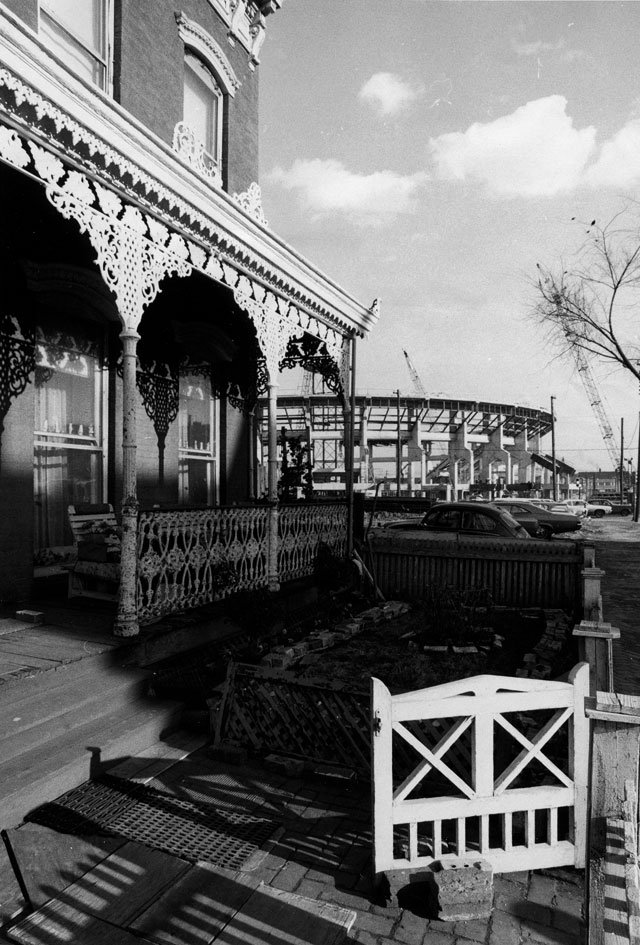
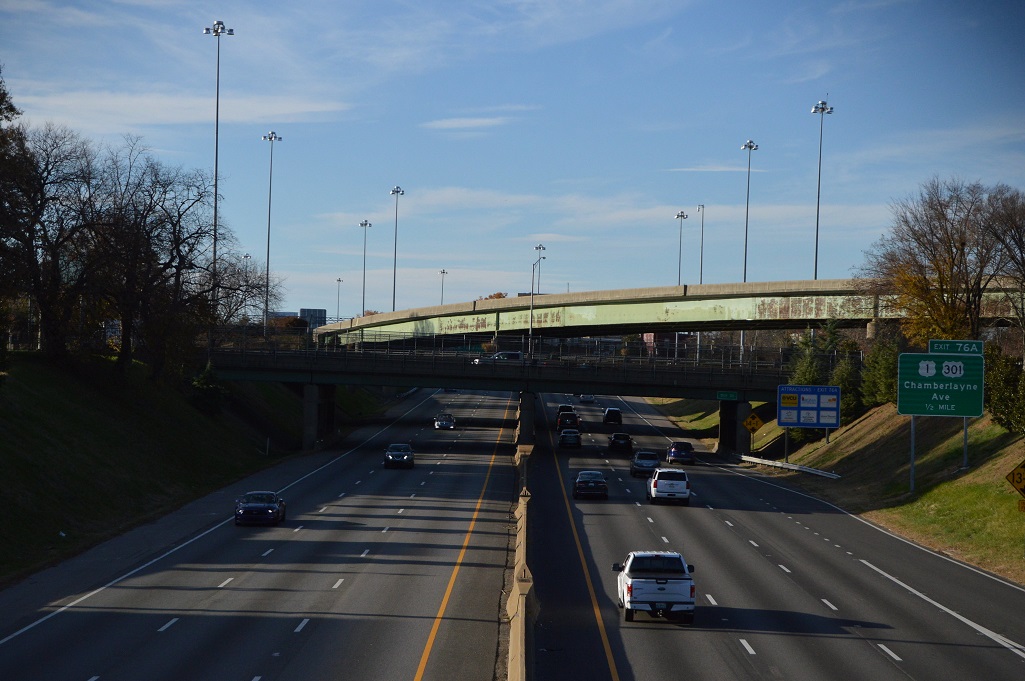
What stands there now
Reynolds Community College and VCU's Medical Center campus cover most of the ground where the houses, the churches, and the school were. The Coliseum covers the rest, for a few more months.
In 1966, Albert Norrell's family was displaced from Navy Hill. Faithe Norrell later said that her relatives were so rooted in the community that many of them died within a year or two of being forced to move. In 2022, Janis Allen, board president of the Historic Jackson Ward Association, marched in Richmond. Her family had lost their home to the same highway.


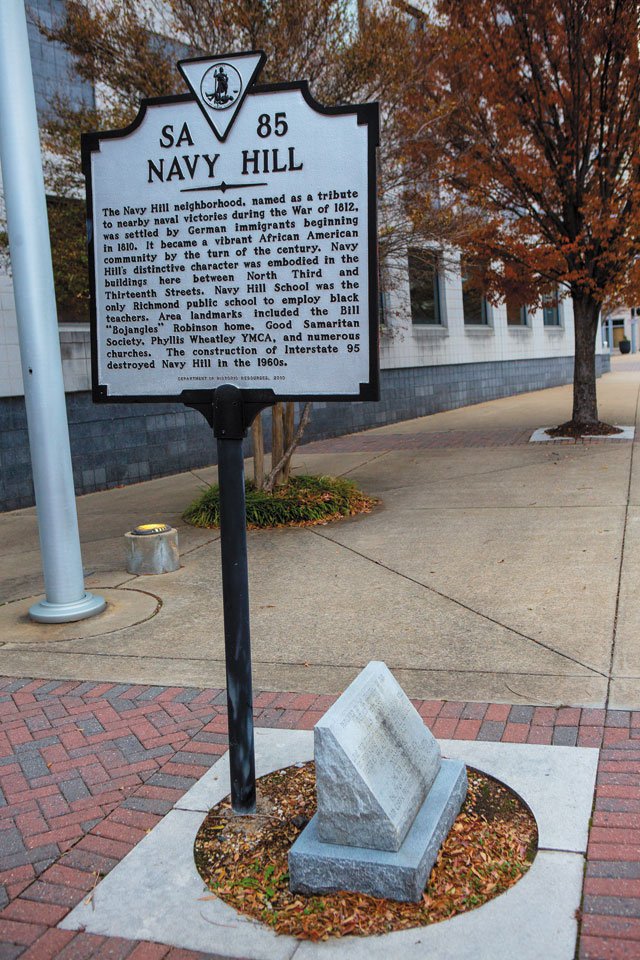
In 1993 a former resident named Rob Curry got a commemorative stone placed near the old school gymnasium. It opens: Love and memories never die. Construction later displaced it, and for years the stone sat on top of a stormwater cover behind a parking deck at Navy Hill Drive and East Duval. The historian Selden Richardson noticed and told the columnist Michael Paul Williams, whose 2011 piece reached Earle Taylor and the retired police chief Willie C. Jones. They got it moved. It rests now on a bed of pebbles beneath a state marker near Fourth and Jackson.
Two of the neighborhood's names are still on the street grid. Duval Street survives on both sides of the interstate, in three pieces that no longer connect to each other. Navy Hill Drive is the service road behind the parking deck.
Navy Hill School stood at Sixth and Duval for ninety-four years. North Sixth Street runs up out of downtown and ends at Leigh.
The nine and a half acres change hands again this year.
The condemnation files, the right-of-way plats, and the assessment rolls are in the Library of Virginia, at VDOT, and in city hall. They record who owned this ground and what the city paid for it.
The ground
The Sanborn Fire Insurance Company mapped Navy Hill at building-level detail across multiple decades. Every structure is drawn to footprint, keyed to its street number, with construction material and use noted. The 1905 and 1925 editions show the neighborhood at its densest. The Library of Congress holds the full set, public domain and freely accessible: Sanborn Maps, Richmond, Virginia. The sheets covering the blocks north of Leigh between Third and Tenth contain the Navy Hill footprint.
Sources
Historical marker SA-85, Virginia Department of Historic Resources, erected 2010.
Harry Kollatz Jr., "The Original Navy Hill," Richmond Magazine, December 2019: Robnette Moore, John Booker, the Sixth Street Market, the commemorative stone, the 1816 plat.
"Navy Hill: From Thriving Black Community to Debated Redevelopment," RVA Mag: Faithe and Albert V. Norrell, Maggie Walker's residence, the Jackson Ward business owners who lived on the hill, the 1966 displacement, family deaths following relocation.
Richmond Public Schools historical file, Navy Hill School: the Richmond Educational Association and R. M. Manly, the Freedmen's Bureau funding, the 1893 building, the 1952 piling depth, the 1965 closure.
"Navy Hill, Remembered," Reynolds Community College, October 2023: Georgette and Clayton Harris.
"Reconnect Jackson Ward," VPM News, October 2022: Kia Player, 904 Turpin Street.
Richmond Family Magazine, "Destroying a Community to Build a Road": the turnpike's non-federal financing, the ten percent displacement figure.
Richmond Magazine, "Inalienable Rights," 2022: the scope of city and RRHA takings.
VPM News and Richmond BizSense, July 2026: the $15 million appropriation and the demolition timeline.
"Reconnect Jackson Ward Aims to Make Residents Whole Again," VPM News, October 2022: Janis Allen, board president of the Historic Jackson Ward Association.
Daniel Webster Davis, Wikipedia, citing John T. Kneebone: born enslaved in Caroline County, 1862; graduated Richmond High and Normal School, 1878; two published poetry volumes.
Blues Armory, National Register of Historic Places nomination, 1976; Wikipedia: Averill and Hall architects, 1910, castellated design.
Photographs: Edith Shelton Collection, The Valentine (barber shop); Richmond Times-Dispatch Collection, The Valentine (school, Taylor home, Coliseum construction); Jay Paul (historical marker); Jimmy O'Keefe, Capital News Service / RVA Mag (I-95 aerial, 1015 N. Seventh Street, Blues Armory, Coliseum exterior).
On dates. Sources give September 16 and September 17, 1965 for the school's closing. Both agree it came without notice.
On the destruction. It is variously dated to the 1950s turnpike or the 1960s interchange and arena clearance. It was both, in sequence, across about fifteen years.